
Short answer: not strictly need , plenty of people quit porn without one. But if you’re asking this question, it’s worth taking seriously, because the honest research on this points in a clear direction: isolation tends to make quitting porn harder, and having someone in your corner tends to make it easier.
Do you really need an accountability partner to quit porn? Here’s what the research actually supports — and what’s just recovery-industry marketing.
Here’s what’s actually supported, what’s just repeated marketing, and how to think about whether this is right for you.
What the Research Actually Supports
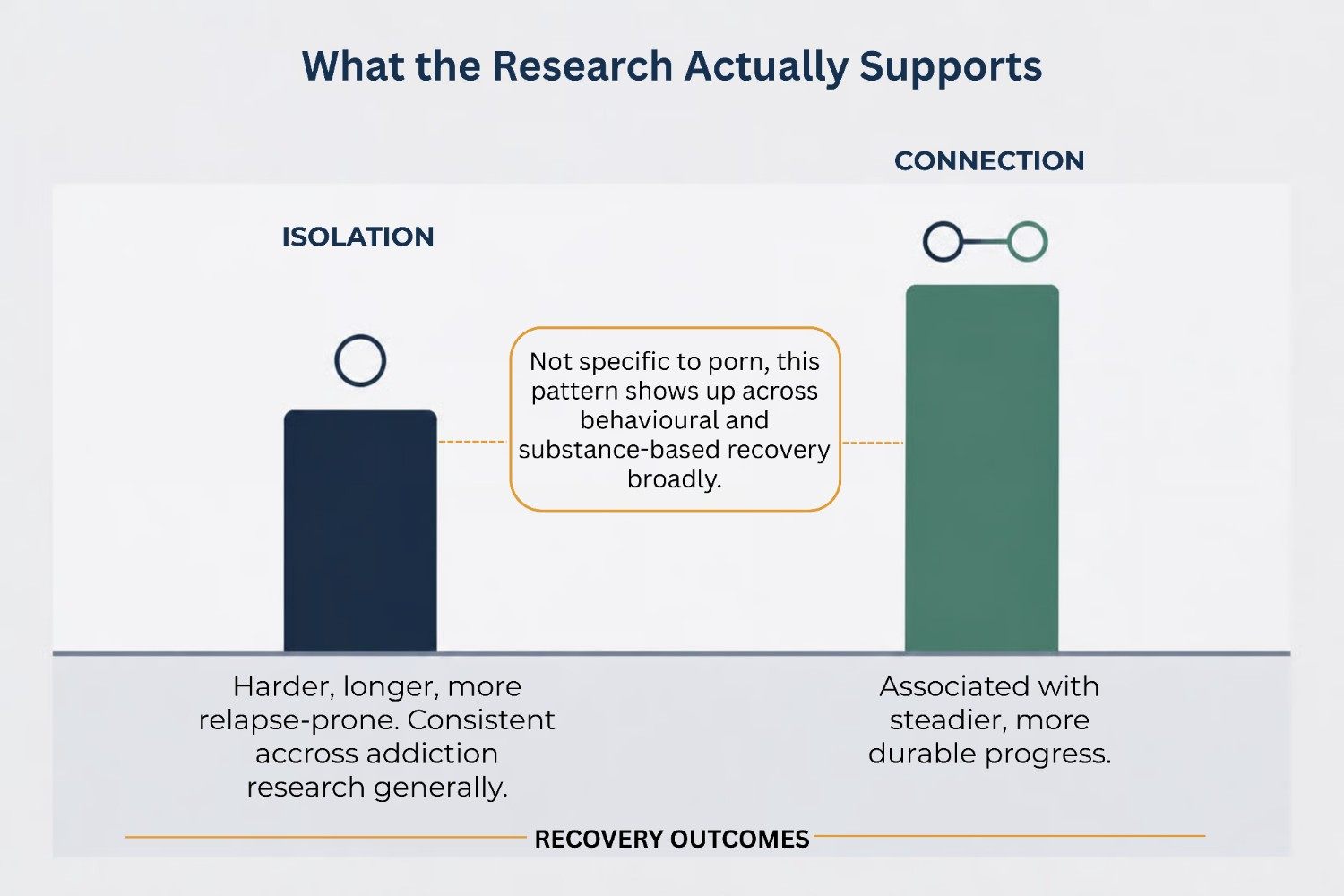
Let’s start with what we can say honestly. Isolation shows up consistently across addiction research , not just for pornography specifically, but across behavioral and substance-based patterns generally , as one of the more reliable factors associated with harder, longer, or more relapse-prone recovery from quitting porn. That’s not a marketing claim; it’s a pattern that shows up repeatedly across the broader addiction and behavior-change literature.
For pornography use specifically, one of the few real clinical trials on this exact topic comes from researchers at Utah State University. Crosby and Twohig ran a randomized trial of Acceptance and Commitment Therapy , a structured, therapist-guided treatment approach , for men struggling with problematic pornography viewing. The results were genuinely strong: participants averaged a 92% reduction in viewing, and just over half had stopped completely by the end of treatment. It’s worth being honest about scope here , this was a small study, 28 participants, and it tested structured therapy broadly, not an accountability-partner relationship specifically. But it does support something relevant: structured, external support meaningfully outperforms trying to white-knuckle this alone.
What’s Just Repeated Marketing
You’ll see a specific number everywhere you look on this topic: that accountability partners increase success rates “by up to 95%.” It shows up, worded almost identically, across a lot of recovery-industry websites. We looked for the actual study behind that number and couldn’t find one. It appears to be a claim that gets repeated because it sounds authoritative, not because it traces back to real research.
We’re telling you this not to argue against accountability partners , the honest case for them doesn’t need an inflated statistic , but because a website that hands you fabricated precision on one thing makes everything else on that page harder to trust. You deserve better than that, especially on something this personal.
What an Accountability Partner Actually Does
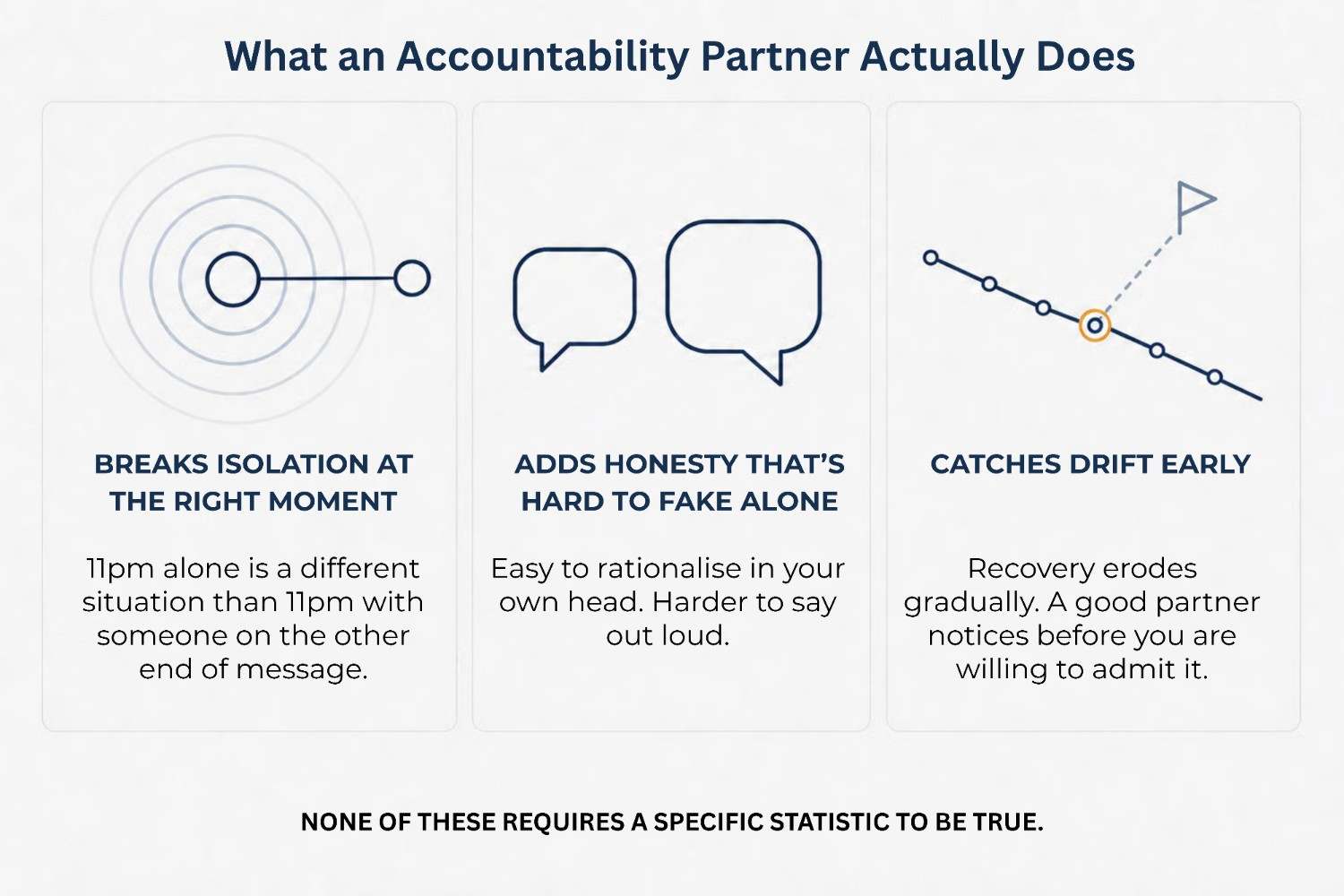
Set the specific numbers aside. Here’s what a real accountability relationship functionally does, based on what’s genuinely well-supported:
It breaks isolation at the exact moment isolation is most dangerous. A craving at 11pm, alone, in a quiet room, is a very different situation than that same craving with a text message and a real person on the other end of it. Watching porn often thrives specifically in secrecy and solitude , removing that condition, even partially, changes the equation.
It adds a layer of honesty that’s hard to fake alone. It’s remarkably easy to rationalize a slip back into porn to yourself in the privacy of your own head. It’s much harder to do that out loud to another person who knows what you’re actually working toward.
It catches drift early. Recovery rarely fails all at once , it tends to erode gradually: a little more secrecy, a little less structure, a missed check-in here and there. A good accountability partner is often the person who notices that drift before you’re willing to admit it to yourself.
What Makes an Accountability Partner Actually Work
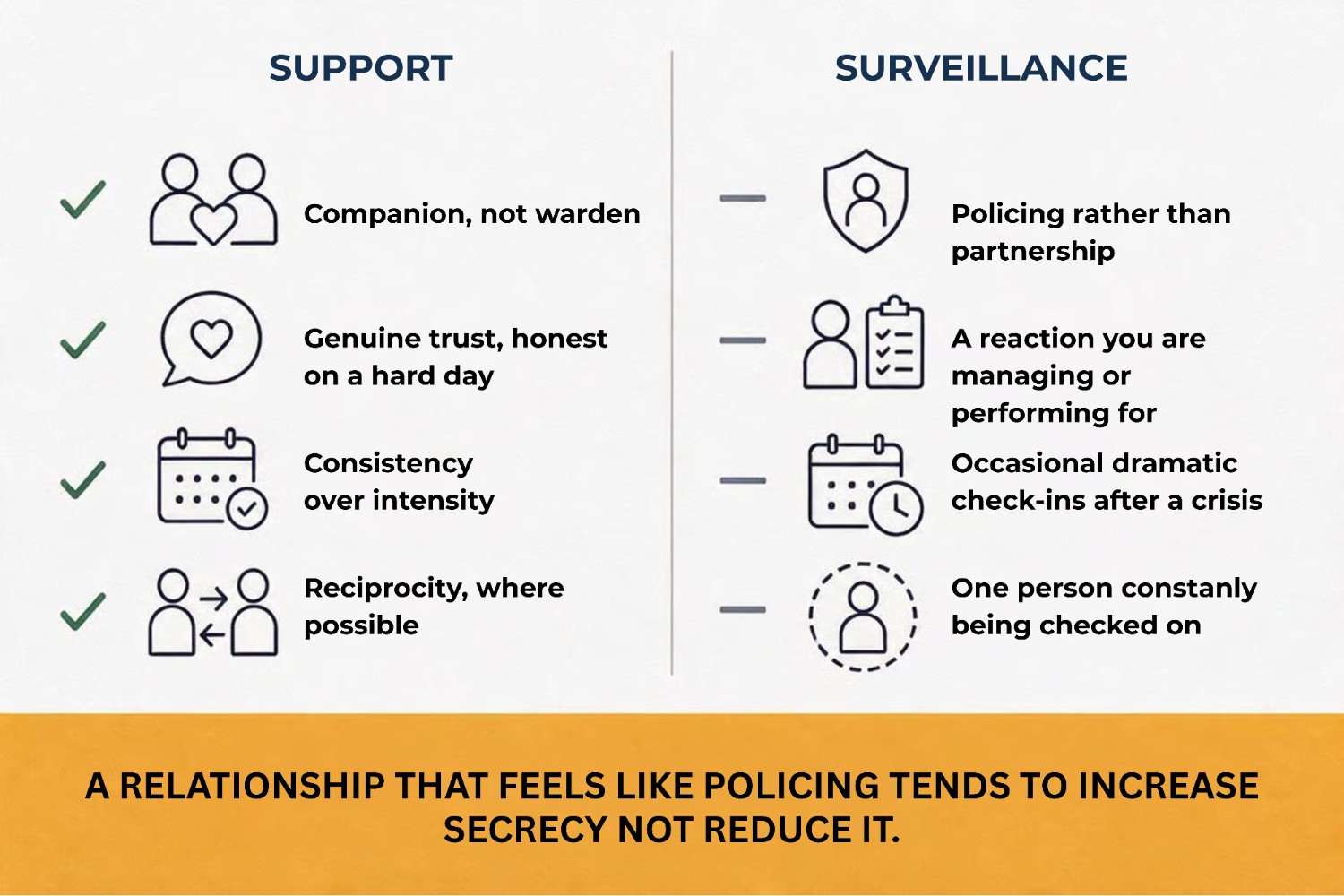
Not every accountability relationship is helpful, and a poorly chosen one can actually backfire , becoming a source of shame rather than support. A few things matter:
- Support, not surveillance. The goal is a companion, not a warden. If the relationship feels like policing rather than partnership, it tends to increase secrecy rather than reduce it.
- Genuine trust. This needs to be someone you can be honest with on a hard day, not someone whose reaction you’re managing or performing for.
- Consistency over intensity. Regular, low-key check-ins tend to matter more than occasional dramatic conversations after a crisis.
- Reciprocity where possible. Relationships where support flows both ways , whether that’s a peer, a structured program, or a group , tend to be more sustainable than one person constantly being “checked on.”
Where to Actually Find One
If this resonates, a few realistic options:
- A trusted friend or partner you can be genuinely honest with , not someone you’d need to perform progress for
- A structured support group, in person or online, built specifically around this kind of recovery
- A coach or therapist who specializes in this area, which combines accountability with actual clinical skill
- A structured program that builds accountability into its design, rather than leaving you to arrange it entirely on your own
That last option is worth naming directly, because arranging genuine accountability from scratch , finding the right person, setting the right expectations, keeping it consistent , is its own project, on top of everything else you’re already working on.
The Honest Bottom Line
You don’t strictly need an accountability partner to make progress. But if you’ve been trying to do this entirely alone and it hasn’t been working, how to stop watching pornography gives you a genuine, non-hyped reason to try something different: isolation is a real, well-documented risk factor here, and breaking it , even imperfectly , tends to help.
You Don’t Have to Build This Alone
If arranging real accountability feels like one more thing to figure out on your own, that’s exactly what Peace Over Pixels’ 4-Week Recovery Reset is built to solve , real structure and real support, built in from day one. It’s free, and it’s where every client begins.
Frequently Asked Questions
Is it true that accountability partners increase success rates by 95%? No , this specific figure appears across many recovery websites without any traceable original study behind it. It’s likely an unsourced or fabricated statistic. What is genuinely supported is that isolation is a consistently identified risk factor in addiction recovery broadly, and structured support tends to outperform going it alone.
What if I don’t have anyone I trust enough to ask? This is common, and it doesn’t mean you’re stuck. Structured support groups, coaching programs, or therapists who specialize in this area can provide the same core function , breaking isolation and adding honest external support , without requiring you to have an existing close relationship you feel comfortable disclosing to.
Can an accountability partner make things worse? Yes, if the dynamic becomes about surveillance or shame rather than support. A partner who reacts with judgment or control tends to increase secrecy rather than reduce it, which works against the entire point of having one.
Is a coach the same thing as an accountability partner? Not exactly, but a good coach often provides a more structured version of the same core benefits , regular check-ins, external honesty, and catching drift early , combined with actual expertise in the recovery process itself, which a peer accountability partner may not have.