

This is one of the most common questions people ask once they’ve decided to actually change , and it’s also one of the hardest to answer honestly, because most of what you’ll find online answers it with far more precision than the evidence actually supports.
You’ll see “90 days.” You’ll see “4 to 8 weeks.” You’ll see detailed day-by-day calendars promising exactly when cravings peak and exactly when they fade. Here’s the honest version: nobody can tell you a specific number, and being skeptical of anyone who confidently does is a reasonable instinct.
What we can tell you is what genuinely affects your timeline, what a realistic general shape looks like, and why comparing your pace to someone else’s is one of the more common ways people derail their own progress.
Why There’s No Single Answer
Quitting porn isn’t a fixed medical procedure with a standard recovery period, the way healing from a broken bone might be. It’s a learned behavioral pattern, built up over time through repetition , and it unwinds the same way: gradually, and differently for everyone.
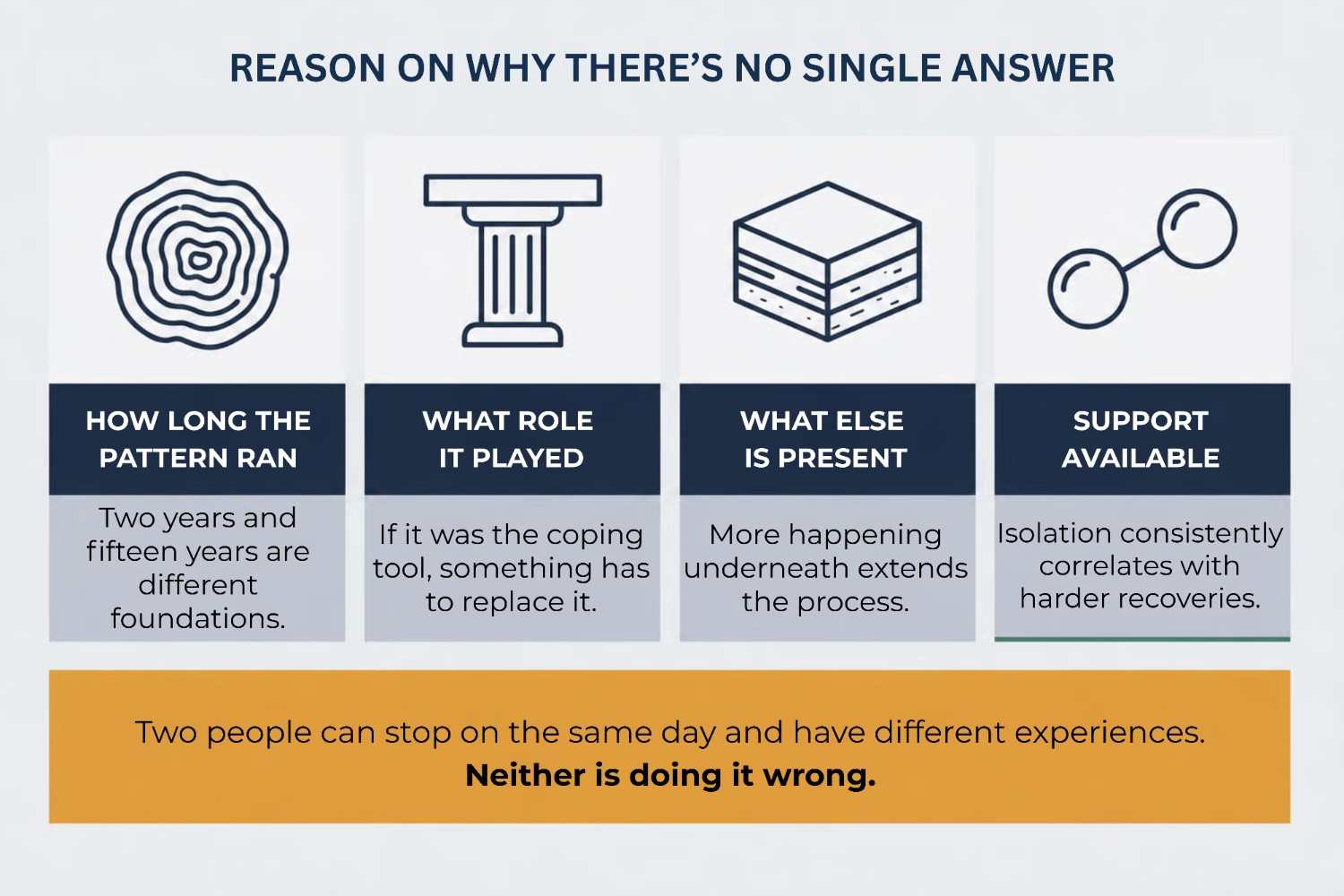
Several factors genuinely shape how long quitting porn takes:
- How long and how frequently the pattern was established. Someone who’s watched porn compulsively for two years is working with a different foundation than someone who’s had the pattern for fifteen.
- What role it played emotionally. If porn was your primary way of coping with stress, loneliness, or difficult emotions, recovery involves replacing that function, not just removing the behavior , which understandably takes longer.
- Co-occurring factors. Depression, anxiety, or other mental health considerations can lengthen the process, not because you’re doing anything wrong, but because there’s more happening underneath.
- The support available to you. Structure, accountability, and outside support consistently correlate with faster, more durable progress than trying to quit porn in total isolation.
Two people can stop watching porn on the same day, with habits that look outwardly similar, and have meaningfully different experiences. That’s not a sign either of them is doing it wrong.
A Realistic (Not Precise) General Shape
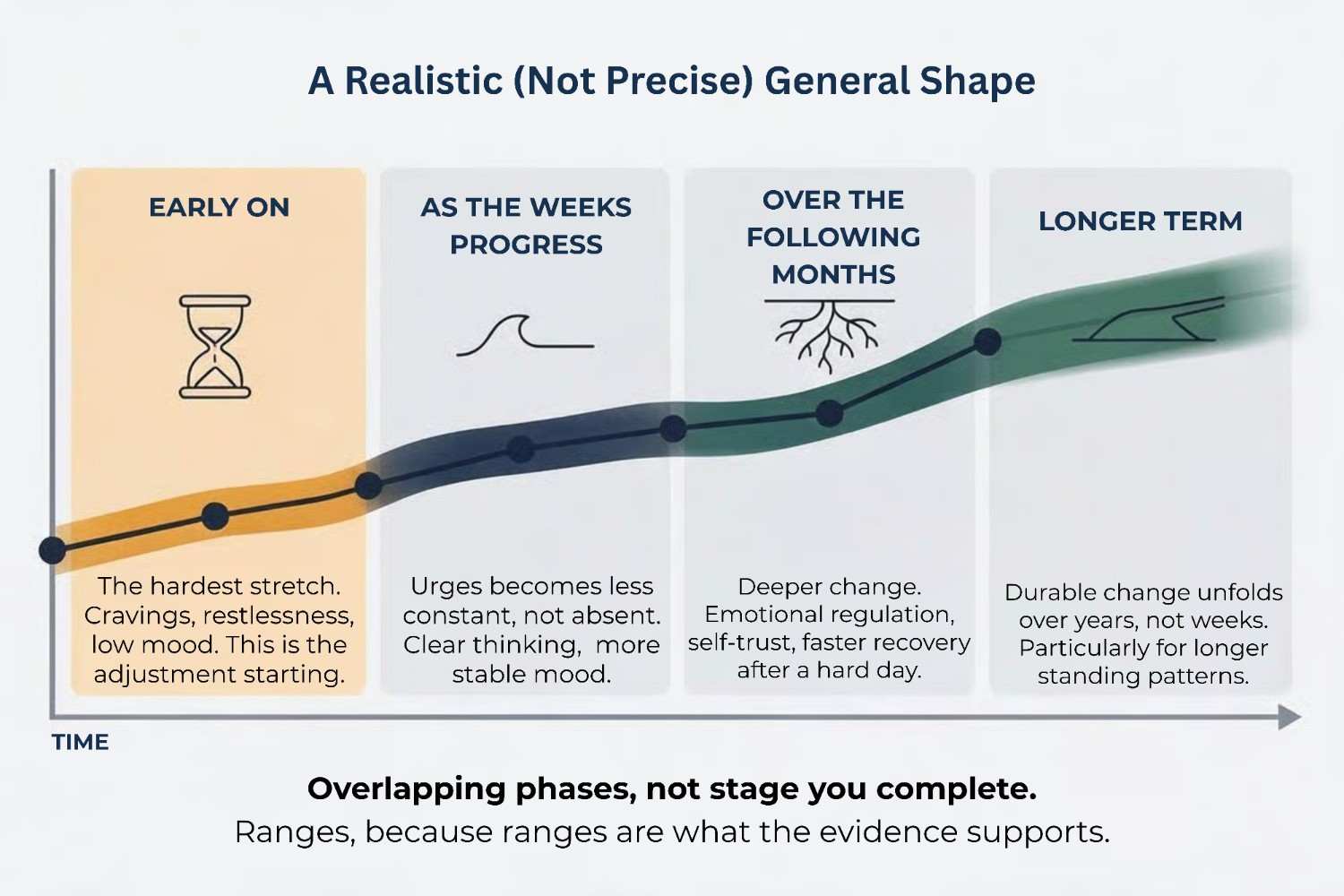
Rather than a confident countdown, here’s a genuinely honest shape of how the process tends to unfold for many people , described in ranges, not exact days, because ranges are what the evidence actually supports.
Early on: This tends to be the hardest stretch after quitting porn. Cravings, restlessness, irritability, and low mood are common as the brain adjusts to the absence of a familiar coping tool. This is uncomfortable, but it’s not a sign anything has gone wrong , it’s a sign the adjustment has genuinely begun.
As the weeks progress: For many people, urges to watch porn gradually become less constant and less intense, even if they don’t disappear entirely. This is often when people start noticing clearer thinking and more stable mood , though, again, the exact timing varies significantly by individual.
Over the following months: Deeper, more durable change tends to unfold here , not just fewer urges to watch porn, but real shifts in emotional regulation, self-trust, and how quickly someone recovers after a hard day.
Longer-term: Some of the more clinically grounded perspectives on quitting porn , including Dr. Patrick Carnes’ widely referenced framework in the sex-addiction treatment field , describe meaningful, durable change as realistically unfolding over a period of years, not weeks, particularly for longer-standing patterns. That might sound discouraging at first read, but it’s actually protective information: it means a hard month eight months into quitting porn isn’t evidence you’ve failed. It’s evidence you’re still in a process that was always going to take real time.
Why Comparing Timelines Backfires
One of the most common ways people can’t stop watching pornography isn’t a lack of effort , it’s comparing their pace to someone else’s story online, then feeling like a failure when their experience doesn’t match a stranger’s confident timeline.
If you’ve internalized “90 days” as the finish line, and day 91 still feels hard, that mismatch between expectation and reality can feel like proof that something is uniquely wrong with you. It isn’t. It’s proof that the number you were given was never realistic in the first place. This is exactly why this article intentionally avoids handing you a specific countdown , a fabricated deadline can do more harm than an honest “it varies” ever could.
What Actually Speeds Things Up
While there’s no shortcut to a fixed number of days, a few things consistently correlate with a smoother, faster-feeling process:
- Structure over willpower , a concrete plan for triggers and urges, decided in advance, rather than relying on motivation in the moment
- Addressing what’s underneath , since the behavior was often functioning as a coping tool, dealing with the stress, loneliness, or emotions it was masking tends to matter as much as the behavior itself
- Real support , isolation is one of the most consistently cited factors in slower or harder recoveries; having someone in the loop tends to shorten the harder stretches, not lengthen them
- Treating slips as information, not failure , as covered in our recovery roadmap, how you respond to a hard day matters more for your overall timeline than whether a hard day happens at all
The Honest Bottom Line
If you came here looking for a number, we understand why , uncertainty is uncomfortable, and a countdown feels like control. But the more useful reframe is this: the goal isn’t to hit a specific day. It’s to keep building a trend in the right direction, with the right support in place, for as long as it genuinely takes for you.
However long your process takes, you don’t have to guess your way through it by yourself. Peace Over Pixels’ 4-Week Recovery Reset gives you real structure and real support for exactly this stretch of the process , free, and where every client begins.
Frequently Asked Questions
Is it true that it takes 90 days to recover? This figure is widely repeated online, but it doesn’t trace back to strong, peer-reviewed research , it appears to have originated from popular recovery-community writing rather than clinical studies. Recovery timelines vary significantly by individual, and treating any single number as a guaranteed milestone can set up unrealistic expectations.
Why does recovery take longer for some people than others? Several factors play a role, including how long and intensely the pattern was established, what emotional function it served, whether other mental health factors are present, and the level of support available. None of these reflect a person’s willpower or worth , they reflect genuinely different starting points.
Is it normal to still struggle after several months? Yes. More clinically grounded perspectives on recovery from compulsive sexual behavior patterns describe meaningful, lasting change as realistically unfolding over a period of years for many people, particularly with longer-standing patterns , not a fixed number of weeks.
Does having support actually make recovery faster? Isolation is one of the more consistently cited factors associated with slower and harder recoveries across the available research and clinical observation. Having real support , whether a coach, therapist, or accountability partner , tends to correlate with steadier, more sustained progress.


